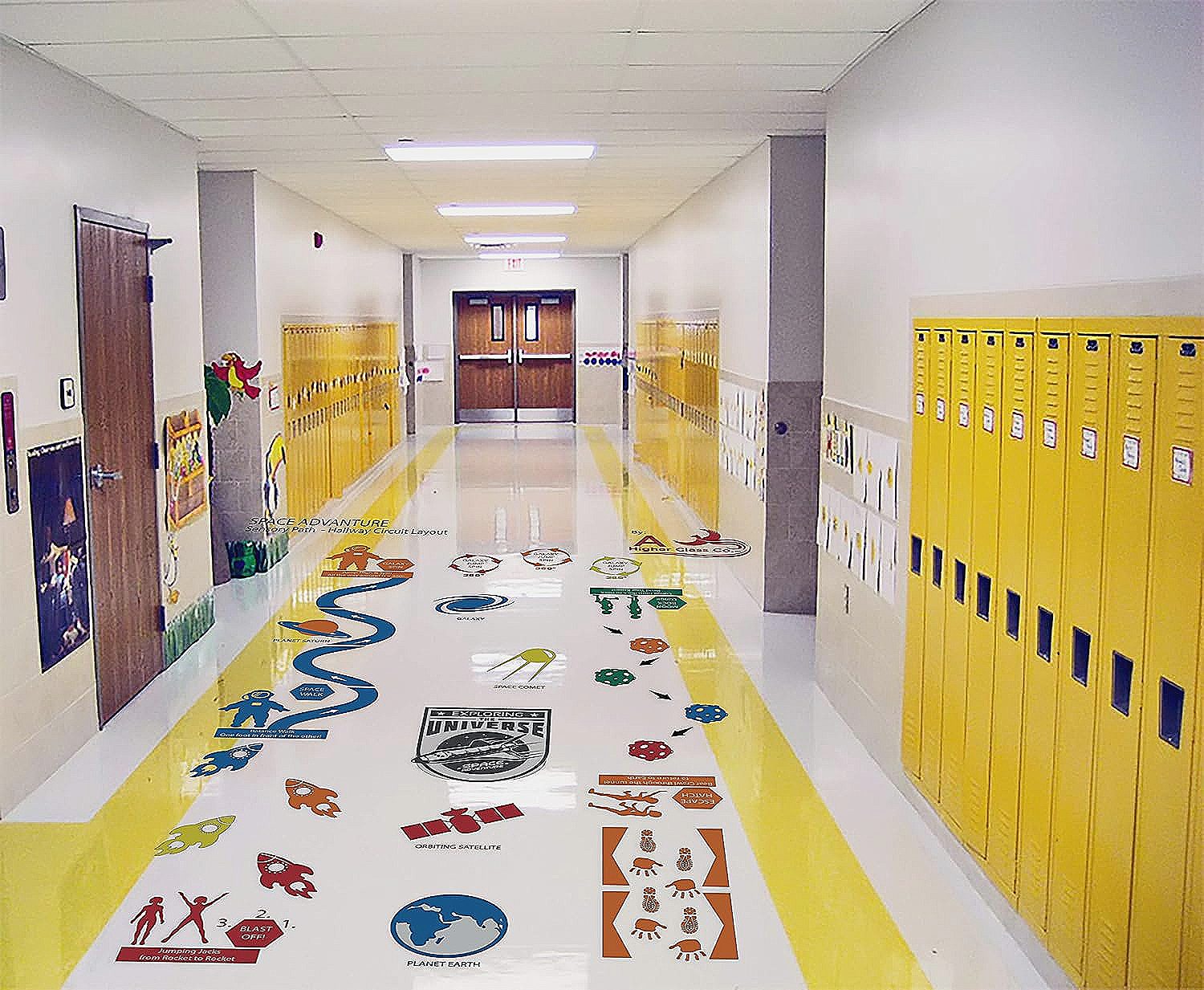
It is 10:40 in the morning, the class has been seated for most of an hour, and the room has that restless hum every teacher knows. A sensory path gives that energy somewhere to go. It is a line of floor decals in the hallway that tells children exactly how to move: crawl like a bear, waddle like a duck, hop like a frog. They take a short turn, then walk back in ready to learn.
The Deluxe 8-Activity Pathway Kit is our most complete hallway path, made for schools, preschools and daycares. Below: what is in the box, how each station works, the skills it practices, what research on movement breaks does and does not say, and how to install it. It is written for teachers, daycare providers, and pediatric therapy and child life teams.
What is in the Deluxe kit
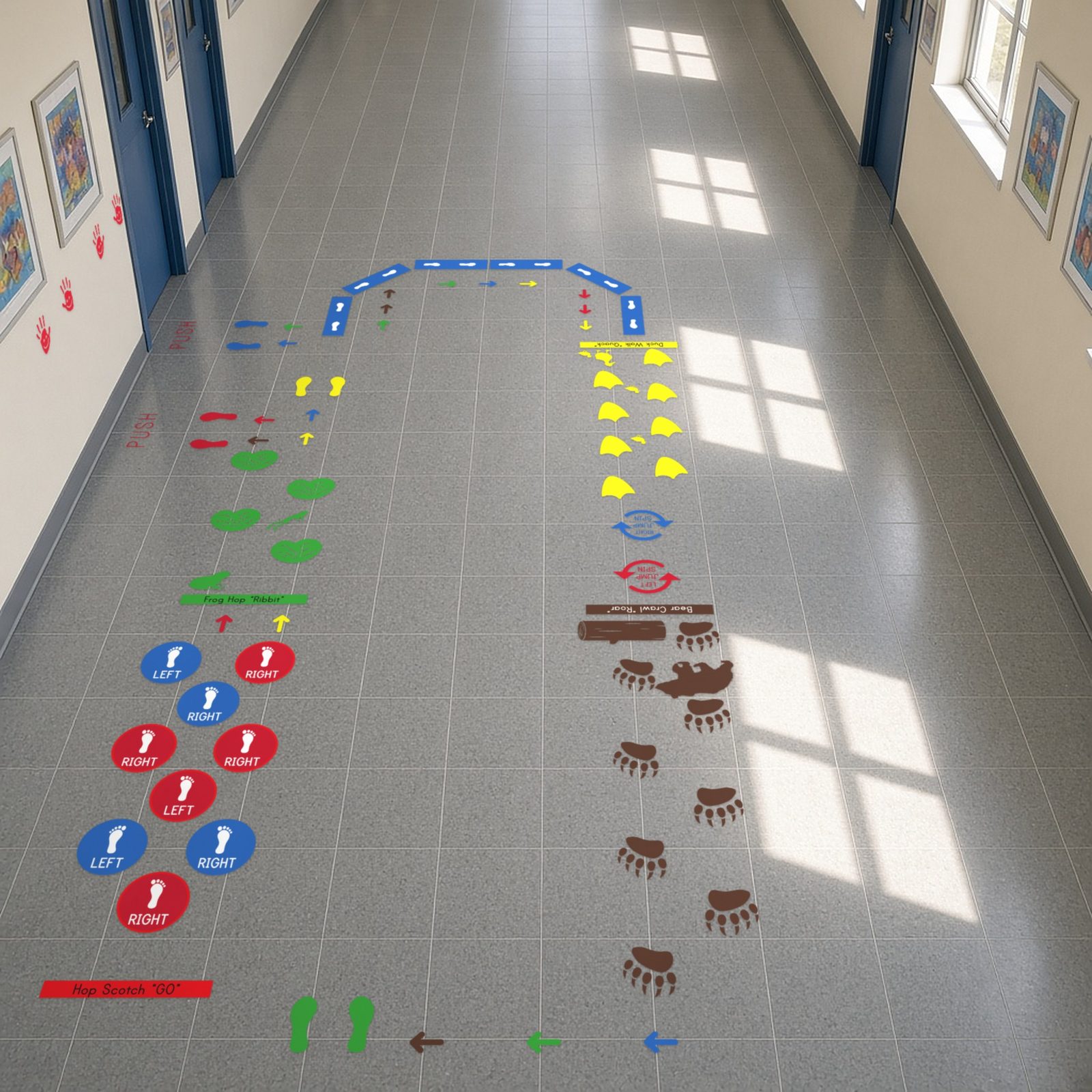
The kit is 65 durable vinyl decals that peel and stick to the floor and wall. Most of our kits ship with an installation squeegee, and a downloadable layout guide is linked from the product page. Every station has its own start line, so children always know where a turn begins:
- Bear Crawl: a “Bear Crawl Roar” start line, 8 bear paw prints, a bear and a log.
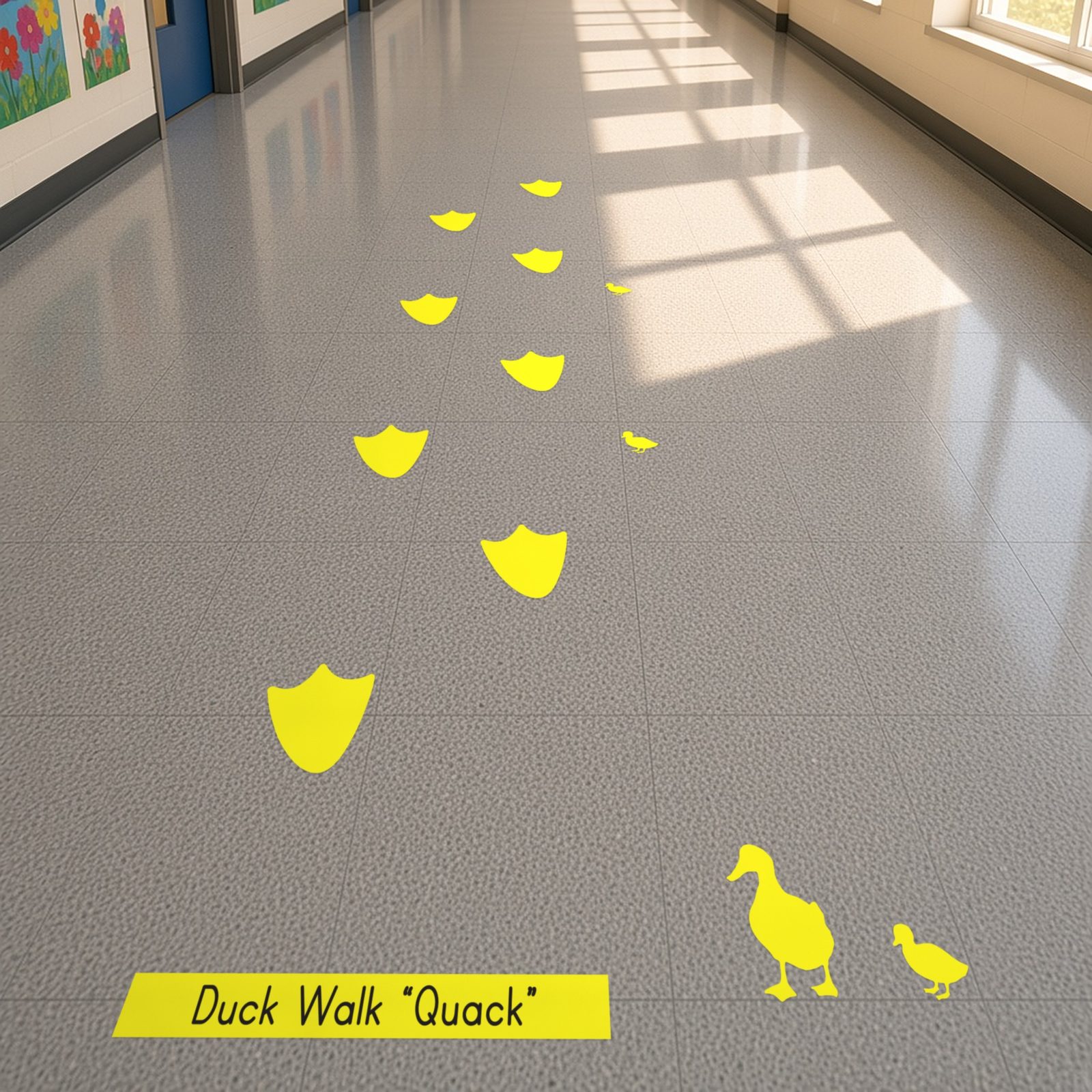
- Duck Walk: a “Duck Walk Quack” start line, 8 duck foot prints, a mama duck and a baby duckling.
- Frog Hop: a “Frog Hop Ribbit” start line, a jumping frog, a sitting frog and 4 lily pads.
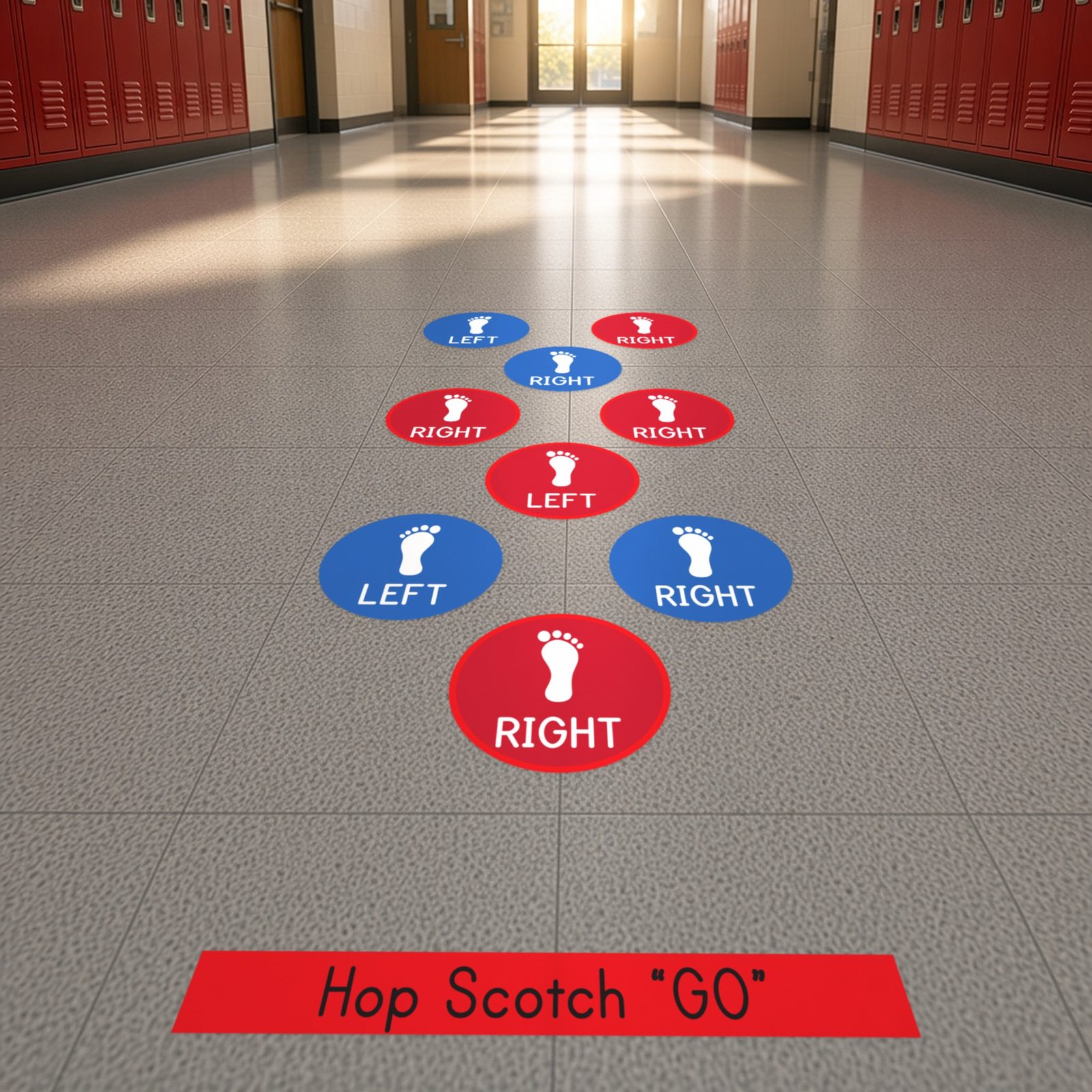
- Hop Scotch: a “Hop Scotch Go” start line with left and right hop prints.
- Balance beams: 6 beams, each 4 inches wide and 18 inches long.
- Wall push: 4 smiling hand prints for the wall, 2 PUSH decals and shoe prints for the floor.
- Jump spins: a “Right Jump Spin” and a “Left Jump Spin” decal.
- Extras: 8 directional arrows to link stations in whatever order suits your hallway.

Station by station: how kids do it and what it builds
Each station is a short, repeatable movement pattern built from pieces therapists will recognize: input to muscles and joints (proprioception), input from movement and balance (the vestibular system), coordinating both sides of the body, and motor planning.

Bear Crawl
Children start at the “Roar” line, put their hands and feet on the paw prints and crawl along the trail with hips up and knees off the floor. Builds: weight bearing through the arms and shoulders, core stability, and opposite-hand, opposite-foot coordination, the cross-body pattern therapists link to crossing the midline.
Duck Walk
Kids drop into a low squat, follow the yellow foot prints and quack at the line. Builds: leg strength, balance in a low position, and the motor planning needed to match each step to a target.
Frog Hop
Children hop with both feet from lily pad to lily pad. Counting hops or naming the colors adds a light academic layer. Builds: two-foot jumping and landing, leg power, and sequencing from one target to the next.
Hop Scotch
Following the left and right hop prints, children hop on one foot, then two, in a set pattern. Builds: single-leg balance, left and right awareness and rhythm. Therapists can make it easier or harder by changing the rule: both feet, one foot, or hop-hop-pause.
Balance beams
Children walk heel to toe along the beams, which you can set straight, in a zigzag or in a U-turn. Try walking forward, sideways and then backward as skills grow. Builds: balance, body awareness and visual attention to the next step, which depends on the vestibular system.

Wall push
Children stand on the shoe prints, place their hands on the smiling hand prints at about shoulder height and push into the wall, a standing push-up. Builds: upper-body strength and the deep muscle and joint input therapists call “heavy work.” It is quiet, so it suits the moments just before a seated task.

Jump spin
The jump spin decals tell children which way to turn. They jump, then spin a quarter, half or full turn to the left or right. Builds: vestibular input, body awareness and planning a turn. Keep turns modest and watch for dizziness; some children seek spinning and others dislike it, so always allow a child to skip a station.
Like what you are reading?
8-Activity Pathway Kit
$299.99
$99.99
Save $200
Why movement breaks are worth the hallway space
The CDC says classroom physical activity can improve concentration and on-task behavior, reduce disruptive behavior such as fidgeting, and increase motivation and engagement.
In a 2006 study at a North Carolina elementary school, teachers led a 10-minute movement activity each day. Among the third and fourth graders observed, on-task behavior during lessons improved by 8% on average, and by 20% for the students who were least on task. A review of 39 studies found a positive effect on on-task behavior too, though results varied widely and the authors could not draw firm conclusions. For test scores the picture is more mixed, with no sign that more activity harms learning.
One honest gap: studies of sensory paths themselves are few and small. A 2020 university thesis with three students, interrupted by school closures, showed no clear benefit. So think of the path as a practical way to deliver the short movement breaks research does support, not as a treatment.
How to use the path
In a school
Use the path for transitions. Send two children at a time on the way to the library or lunch, or offer a station before a test or a long read-aloud. Choose one or two stations a day and rotate. Turns should be quick: the goal is to wake up the body, not run a race.
In a daycare or preschool
For younger children, lean on the animals. The bear, duck and frog stations invite pretend play, and the path gives a rainy day somewhere to go. Keep groups small and demonstrate each movement yourself.
In a hospital or therapy hallway
Pediatric occupational and physical therapists can use the stations as a ready-made circuit for balance, jumping, crawling and motor planning, graded to each child’s plan. Child life teams can use it for play, which the American Academy of Pediatrics describes as a core tool for development and coping in health care settings. Before you install in a clinical corridor, ask facilities and infection prevention about decals on floors, cleaning and egress, and have the child’s therapist decide which stations are appropriate.
Installing the Deluxe kit
- Pick the right floor. Vinyl decals stick best to clean, dry, smooth, hard floors such as sealed tile, linoleum or vinyl composition tile. Carpet, rough concrete and freshly waxed floors are poor candidates. Try one decal in an out-of-the-way spot first, and ask your custodial team about the floor finish.
- Plan before you peel. Mock up the layout with masking tape, keep the path to one side so traffic and exits stay clear, and leave room at each start line for children to wait.
- Peel, place, press. Work from one end and squeegee from the center out. Our product listing says the adhesive is safe on floors and walls and can be removed later without residue.
- Think about grip. If your hallway is polished or often damp, look at the Anti-Slip 6-Course Pathway. The single-activity Bear Crawl, Duck Walk, Frog Hop and Traditional Hopscotch kits also come in a Traction Control Vinyl (Anti-Slip) choice.
Is the Deluxe kit the right one?
Choose the Deluxe kit for the widest mix of movements in one hallway. For a theme, see our guides to the Space Adventure and Circus kits, or the Rainbow Walk for letters, numbers and shapes. Need help measuring? Call (503) 409-8617.
Questions teachers and clinicians ask
How many decals are in the Deluxe sensory path kit?
The Deluxe 8-Activity Pathway Kit has 65 durable vinyl decals: Bear Crawl, Duck Walk, Frog Hop and Hop Scotch stations, 6 balance beams, wall push hand prints and PUSH decals, left and right jump spin decals, shoe prints and 8 directional arrows.
How long should a sensory path movement break last?
A few minutes per group is a practical place to start. In one classroom study, teachers led about 10 minutes of movement a day. Choose one or two stations, keep turns quick, and adjust to your schedule and the children in front of you.
Will the decals damage a school floor?
Our product listing says the adhesive is safe for floors and walls and can be removed later without residue. Floors differ, so test one decal in an out-of-the-way spot first and ask your custodial team about the floor finish.
Can children with sensory or motor challenges use the path?
Many do, with choice and supervision. Let children skip any station, keep spinning modest, and ask a child's occupational or physical therapist which stations fit their plan. A sensory path is a movement tool, not a treatment.
Can we install it in a hospital or therapy hallway?
Often yes, but check first. Ask facilities and infection prevention about floor decals, cleaning and keeping exits clear. If your facility needs specific information about the vinyl, call us at (503) 409-8617 before you order.
Bring the wiggles out of the classroom and into the hallway.
8-Activity Pathway Kit
$299.99
$99.99
Save $200
Sources and further reading
- CDC: Classroom Physical Activity (Physical Education and Physical Activity) Centers for Disease Control and Prevention, updated June 26, 2024.
- Mahar MT, et al. Effects of a classroom-based program on physical activity and on-task behavior. Medicine & Science in Sports & Exercise, 2006 One school; students in grades K-4 for activity, grades 3-4 for on-task observation.
- Watson A, et al. Effect of classroom-based physical activity interventions on academic and physical activity outcomes: a systematic review and meta-analysis. International Journal of Behavioral Nutrition and Physical Activity, 2017 Systematic review of 39 studies; the authors note results vary widely between studies.
- Donnelly JE, et al. Physical Activity, Fitness, Cognitive Function, and Academic Achievement in Children: A Systematic Review. Medicine & Science in Sports & Exercise, 2016 (ACSM position stand) Reports mixed results for test scores and no sign that more activity harms learning.
- Keene H. An Evaluation of Sensory Paths as an Antecedent Intervention for Decreasing Off-Task Behavior in Children with Disabilities During Small Group Instruction. University of Kentucky master's thesis, 2020 A small thesis (three students), not a peer-reviewed trial; the author calls for more research.
- Romito B, et al. Child Life Services. Pediatrics, 2021 (AAP Committee on Hospital Care and Association of Child Life Professionals) Policy statement; describes therapeutic play as a core child life tool.
This guide is general information for educators and care teams. It is not medical advice and does not replace an individualized plan from a child's occupational therapist, physical therapist or physician.